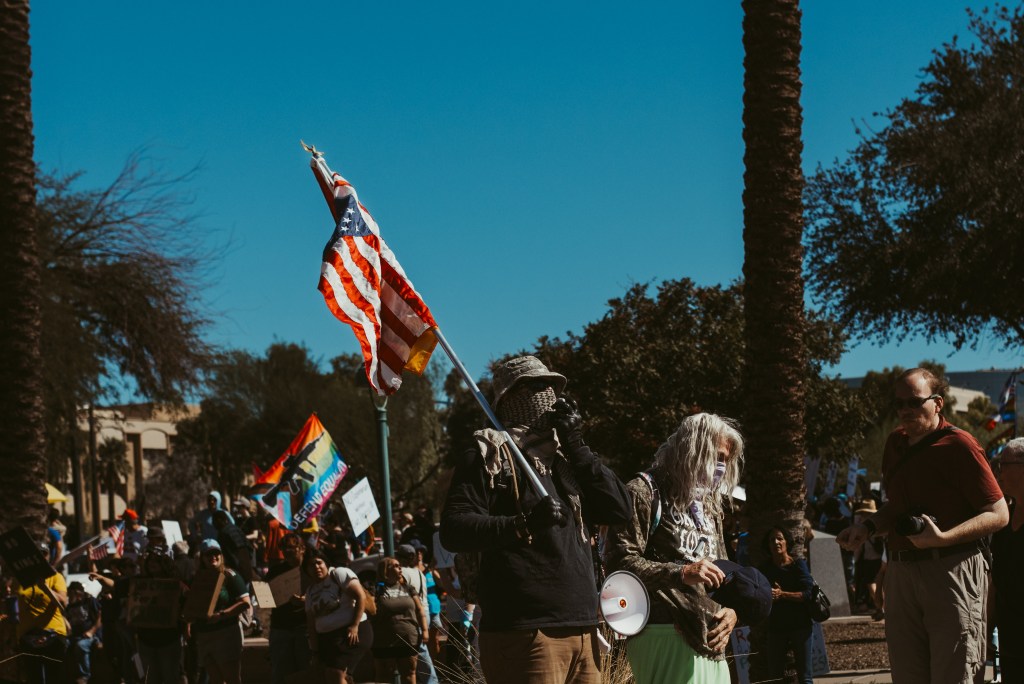
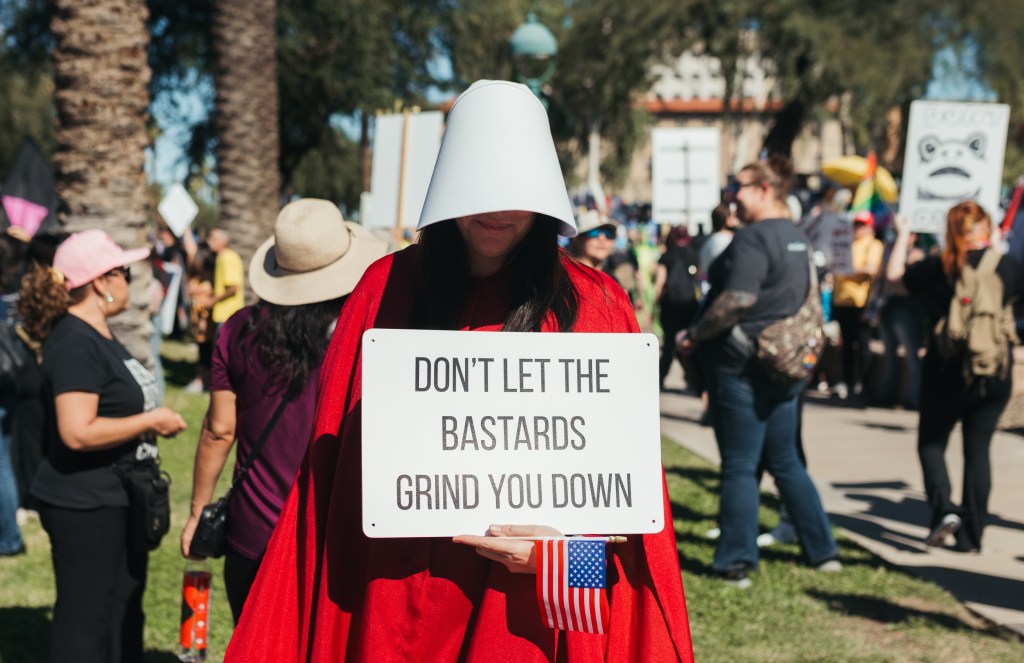
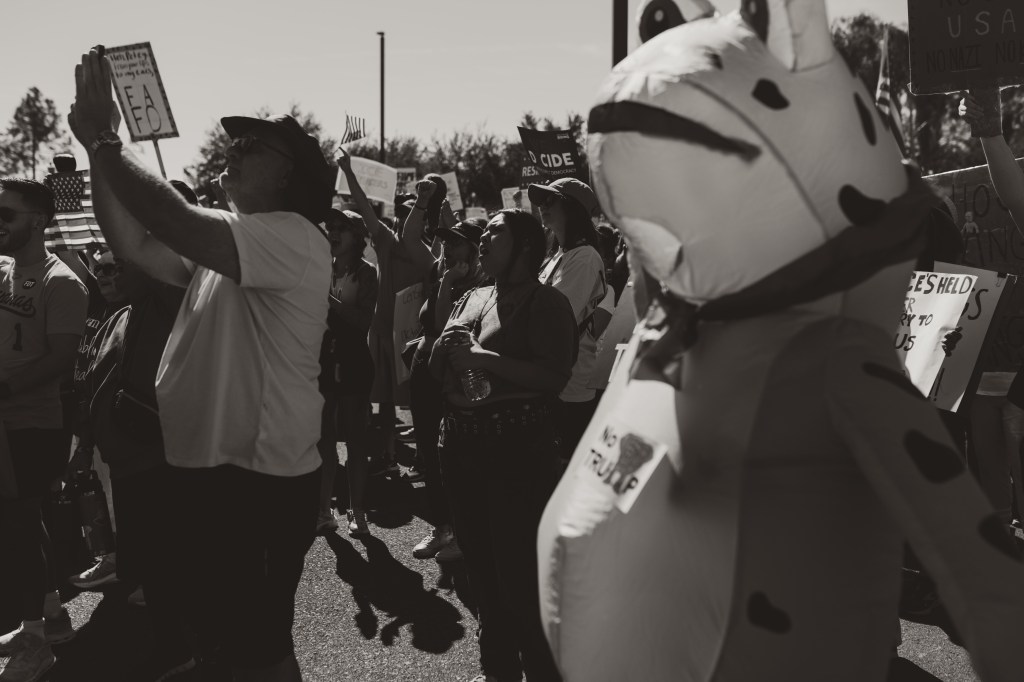
Over the last couple of days I’ve watched clips and photos from the ‘No Kings’ protests. It was beautiful seeing thousands of people flooding the streets with urgency, grief, hope, and conviction. But then I opened the comments on those clips and my stomach dropped. It’s like I was seeing two completely different realities. My mind couldn’t wrap around the reality where protesters were “paid actors” or where the crowds were “tiny” or where the movement was “fake” or “overblown.”
Same protests. Same videos. Same cities.
Two completely different realities and two completely different stories.
Many of us have been feeling this for a while now. There is the reality so many of us are living in… and then there’s a second reality that insists none of it is real or serious or worth paying attention to. I don’t know how to hold that disconnect anymore without naming it out loud.
In my reality – and in the reality of so many queer, trans, immigrant, and marginalized people – politics isn’t theory. It isn’t entertainment. It’s the air we’re allowed to breathe and the space we’re allowed to exist in. When lawmakers debate our rights, they’re not debating ideas – they’re debating us. Our relationships. Our bodies. Our ability to live without fear.
So yes, I and we pay attention. We notice the rhetoric. We feel it in our nervous systems when a new bill gets proposed or when a politician or influential person uses language that paints us as threats, problems, or punchlines. We don’t have the luxury of tuning it out, because it follows us into bathrooms, doctor’s offices, family gatherings, and courtrooms. It shapes whether we can get married, adopt or have kids, access healthcare, or simply walk down a street without wondering who sees us as less than human.
And we are not imagining it.
We are responding to it.
Meanwhile, there’s a whole other America where these same issues register as noise, exaggeration, annoyance, or “just politics.” It’s a world where people can say, “It doesn’t affect me,” or “I don’t pay attention to that stuff,” because their rights, marriages, identities, and safety are not up for public debate. To them, the protests look dramatic, the fear looks irrational, and the urgency feels confusing.
I have to tell myself that it’s not that they’re all cruel – many truly don’t understand. But that’s the fracture: one group is living the consequences, and the other is living the convenience of not having to know (or of knowing and of not caring).
At the very same time, life keeps happening in ordinary and beautiful ways. I wake up to five dogs jumping on me, demanding cuddles and breakfast; I go dancing; I plan a wedding; I laugh with friends. I fold laundry, answer emails, wait in line for coffee, and try to remember what it feels like to be fully present.
There are days the sun hits just right and I feel soft, hopeful, and human. And yet, underneath those simple, joyful moments is a constant hum. A background siren only some of us seem to hear. It doesn’t stop me from living, but it never really goes silent either.
It’s the weirdest thing: to hold joy in one hand and dread in the other. To slow dance in the kitchen with the person you love, while knowing people are debating whether your love deserves protection. To plan a future, while a part of you whispers, ‘Will we even be safe or alive for that future?’. To post photos of happy moments, while scrolling headlines that make your stomach drop.
The world expects us to live as if things are normal. And in many ways, we do. We create routines. We celebrate milestones. We cling to the soft moments of daily life. But it all exists with an undertone of alarm – and pretending the ground isn’t shifting doesn’t make it stable.
Living inside these overlapping worlds does something to your mind and your heart. It’s like emotional whiplash – to experience something as urgent, dangerous, or real, and then watch people you know and love insist that nothing is happening. I start to question my footing and my sanity. Not my values, not my identity, but my reality. The ground feels less solid. Conversations feel less safe.
It becomes harder to trust – not because I’m closed off or unwilling to hear other perspectives, but because I’m realizing that some people aren’t even looking at the same world that I am. They’re reacting to a different set of “facts,” a different narrative, a different story about what this country is and what it’s becoming. And how do we build understanding when we can’t even agree on what exists?
The split takes a relational toll. I’ve pulled back in some spaces. I’ve softened myself in others. I’ve learned which people can hold the truth with me and which people shut down, minimize, or change the subject. It’s lonely – not because I’m alone, but because I can feel the distance between realities widening, even in rooms full of people.
Meanwhile, there’s a deeper grief underneath it all: the grief of losing a shared sense of reality with our own community, our own country. We were taught to believe in some version of a common truth, a common good, a common story. But now? It feels like everyone is watching a different movie and insisting theirs is the only one playing.
And the nervous system can’t help but react and respond. One moment I’m calm and laughing, and the next moment I’m bracing – not because something happened, but because something could happen.
Holding two realities at once comes with a price. It’s not always visible, but it’s there – in the tightness in my chest, the interrupted sleep, the instinct to scan a room as soon as I enter and every minute before I leave, the urge to check the news even when I don’t want to know. It’s there in the mental gymnastics of switching between “alert” and “okay,” between I’m fine and am I?, between planning a future and wondering how much of it will still exist.
There’s a fatigue that’s settling into my bones. When I’m constantly translating my reality for people who don’t see it, or won’t. A loneliness in having to explain why I’m afraid, or angry, or paying attention.
No one teaches you how to hold tenderness and vigilance in the same body without burning out.
But somehow, I do and we do. We keep going. Because the alternative is to go numb, and numbness is its own kind of death. I’ve lived in that space before and I don’t want to go back.
But there is hope. Not the easy kind, but the kind that’s like flowers growing through cracks in pavement. The kind that exists because people insist on caring anyway, even when it feels impossible.
Hope lives in the communities that refuse to look away – in family and chosen family, in organizations that are fighting every day, in artists, in therapists, in teachers, in neighbors who show up to protests with signs, snacks, and open arms. Hope lives on the dance floor, in laughter, in strangers locking arms at protests, in people feeding each other, protecting each other, learning from each other, believing in each other.
And hope also lives inside each one of us – in resilience built over years, in the wisdom of therapy and healing, in the body that keeps breathing through fear, in joy that resurfaces even when it has every reason not to. It’s in the relationships that feel like home, in love that stays, in futures we plan anyway. Even now. Especially now.
Hope isn’t loud. Sometimes it’s just a steady pulse saying, Keep going. You’re not alone. There’s more to build.
I can’t control the split in realities. But I can control what I choose to stand for, and who I stand with.
I choose to stay awake, even when it would be easier to shut down.
I choose to protect my joy, because joy is not a distraction – it’s a strategy.
I choose community over isolation, connection over comfort, truth over silence.
I choose to build a life with integrity, even when the ground is unsteady.
I choose love that is deep, chosen, and unapologetically queer.
I choose to believe that our stories matter – not because they’re easy, but because they’re real.
The world can debate my existence if it wants. I’m done debating my humanity and my sanity.
If you’ve gotten this far reading this and you feel the same split – the same disorientation, the same grief, the same whiplash between what you know and what people claim is “not happening” – I want you to hear this: you are not alone. There are millions of us living in this double exposure, navigating the same fault lines, holding the same tension in our bodies.
And we have work to do. Not just to resist what harms us, but to build what sustains us. To keep telling the truth. To keep showing up for each other. To keep making communities that feel like solid ground. To keep experiencing joy. To keep dancing. To keep moving forward.
Two realities may exist right now, but I’m choosing the one rooted in empathy, truth, and community. The one that refuses to look away. The one that keeps loving, keeps fighting, and keeps hoping.
If you’re living in that reality too, I’m right here with you. Keep going. Keep breathing. Keep choosing to care. We aren’t as alone as we’re made to feel.
Until next time,
Chelsea – aka River
 CKB Coaching, LLC